
Most rooms in Czech apartments are lit by a single ceiling fixture — a pendant or flush-mount in the centre of the space. That single source creates flat, uniform light that casts few shadows, makes it difficult to distinguish zones within a room, and often produces uncomfortable glare. Layered lighting addresses this by splitting the work across three distinct source types, each serving a different purpose.
The Three Layers
Ambient (General) Lighting
Ambient light is the foundation. It provides enough illumination to move around safely and complete general tasks without eyestrain. In a typical living room of 20–25 m², a target illuminance of 150–200 lux at floor level is sufficient for ambient use. Recessed downlights on a grid, indirect cove lighting bounced from the ceiling, or a large diffuse pendant all work. The key is even distribution without hotspots.
In Czech practice, the standard panel-style LED ceiling fixture delivers adequate ambient light but almost nothing else. Replacing or supplementing it with dimmable recessed LEDs spaced 1–1.2 m apart along the room perimeter changes the whole character of the space.
Task Lighting
Task lighting is placed specifically where work happens — reading, cooking, desk work. It needs to be closer to the surface than ambient light and bright enough to prevent eyestrain: 300–500 lux at the working plane is the typical target. Kitchen counter strips under upper cabinets, a pendant over a dining table at 65–70 cm above the surface, an adjustable desk lamp with a colour temperature of 3000–4000 K — each of these serves task lighting functions.
A common mistake is placing task lighting so that the user's body casts a shadow on the work surface. For counter lighting, the fixture should be at the front edge of the upper cabinet, not recessed behind it.
Accent Lighting
Accent lighting draws attention to specific objects, surfaces or architectural features. Its defining characteristic is contrast: an accent source should be 3–5 times brighter at the target than the ambient level around it. LED track spots, adjustable recessed heads, and LED strip lights behind shelving all perform accent functions.
In practice, accent lighting is the most skipped layer in Czech residential interiors, partly because it requires additional wiring points and partly because its contribution is less obvious when shopping for fixtures. It has a significant effect on perceived room quality despite contributing relatively little to total energy consumption.

Planning the Layers in Practice
Start with Wiring Points
Retrofitting a layered scheme into an existing room is possible with surface conduit, but the cleanest result comes from planning wiring during renovation. A living room serving as both a sitting area and a workspace benefits from at least four separately switchable or dimmable circuits: perimeter downlights, a central pendant, task points and accent points. Czech wiring norms (ČSN EN 60364) require that lighting circuits be protected by a 10 A breaker; grouping circuits logically also makes scene control practical.
Ceiling Height Matters
Standard Czech apartment ceiling height runs 2.5–2.7 m. At this height, recessed downlights with a 38–45° beam angle create a useful cone that covers roughly 1.2–1.5 m of floor diameter from 2.5 m. Narrower beams (25°) are better for accent use; wider diffusers (60°+) work for ambient wash. Panel-style LED fixtures cover well but lack directionality.
Avoid Mixed Colour Temperatures
Within a single room or open-plan zone, mixing 2700 K warm sources with 4000 K cool-white sources creates a visually uncomfortable result that no amount of dimming will correct. Pick one range and stay in it. For living spaces, 2700–3000 K is the standard recommendation; for kitchens and bathrooms, 3000–4000 K works better.
Fixture Types and Their Layer Role
Recessed Downlights (LED)
Recessed downlights are the most versatile ambient and accent fixture type. Available in fixed and adjustable versions, with GU10 replaceable modules or integrated LED arrays. For dimmable installations, check that the driver is compatible with your dimmer type — not all LED downlights work with leading-edge (phase-cut) dimmers. Trailing-edge (ELV) dimmers are more widely compatible with LED drivers. See the smart dimming guide for more detail.
LED Strip Lights
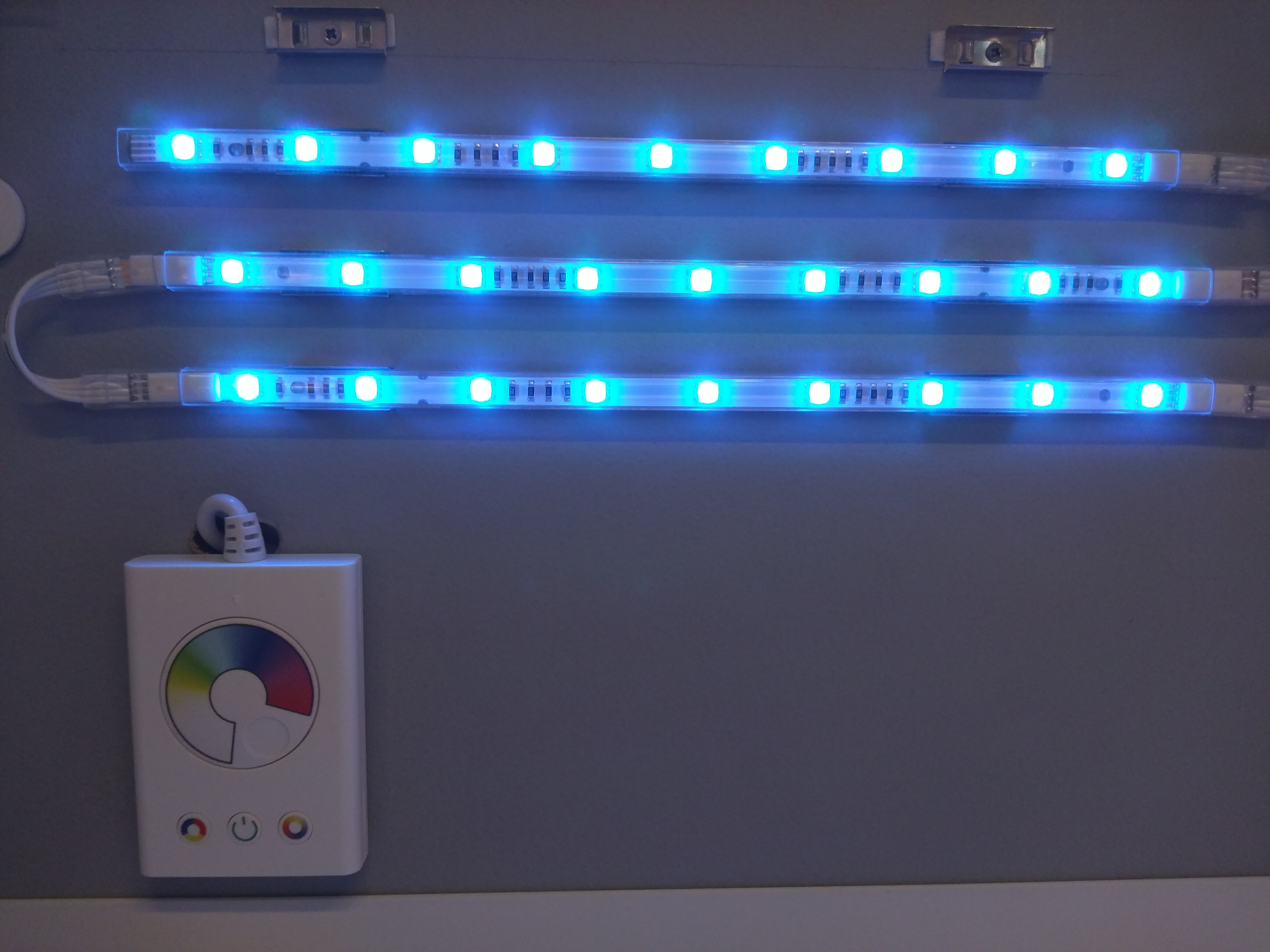
LED strips (typically 12 V or 24 V DC, driven by a small constant-voltage driver) are used for cove lighting, under-cabinet strips, shelf backlighting and furniture reveals. Key specifications: LED density (LEDs per metre), chip quality (Ra/CRI value should be 80 or above for living areas, 90+ for kitchens), and IP rating for damp areas. Warm-white strips in the 2700–3000 K range are standard for living spaces.
Pendants
A pendant over a dining table serves both task and visual anchor roles. Height is critical: 65–75 cm above the table surface is the general range, adjusted so the shade bottom is at or slightly below seated eye level of the tallest likely user. Multiple smaller pendants over a long table (3+ over a 180 cm table) spread light more evenly than a single large unit.
Track Lighting
Three-circuit track systems allow independent switching of fixtures on the same rail — useful where the track runs along the long axis of a room and serves both ambient and accent roles. Track spots with adjustable heads are the practical choice for accent layers over shelving, art or architectural features.
Energy Consumption Reference
A typical layered scheme for a 20 m² living room — eight recessed downlights at 5 W each, two accent spots at 7 W each, one pendant at 8 W — draws roughly 62 W at full output. Running at 50 % dim level on average, that is approximately 31 W, or about 0.74 kWh per 24-hour period. At Czech electricity prices of roughly 5 CZK/kWh (2025 reference), the annual lighting cost for that room is around 1,350 CZK — considerably less than the equivalent incandescent scheme would have cost.
Related reading: Colour Temperature Selection Tips | Smart Dimming Systems for LED Homes
Last updated: 1 May 2026